
We look for businesses that can turn today’s investment into lasting earnings growth. At Meta, that means understanding how artificial intelligence, or AI, could make the services people already use more valuable. People come to its apps to connect, discover, and be entertained; businesses pay to reach them. AI could help Meta serve both groups better.
Our investment case begins with that established business. New services could give Meta a larger role in its customers’ lives, but they will also require significant investment and time to develop. With so much at stake, we assess how that investment could flow back to shareholders and whether the price we pay leaves room for disappointment.
How does Meta make money?
Meta's family of apps includes Facebook, Instagram, WhatsApp, and Messenger. In June 2026, an average of 3.6 billion people used at least one of these apps each day. Businesses pay to reach this audience, and advertising generated almost 98% of revenue in the second quarter. Meta serves a global audience, with more than half of revenue coming from users outside the US and Canada.
What businesses buy is advertising space and the ability to reach people likely to respond. A business owner ultimately cares about the customers, bookings, or sales an advert produces. To see how AI might improve that service, the clearest approach is to follow the advertiser’s money.
Here’s a simple, hypothetical example. A business spends $1,000 advertising on Instagram and receives 20 orders. Its advertising cost is $50 per order.
Now suppose better AI helps select the audience, improve the advert, and decide when to show it. The same $1,000 produces 25 orders, bringing the cost down to $40 per order. For the business owner, that means five more orders from the same advertising budget.
Meta still earns the same $1,000 initially. But it sells advertising through auctions, where businesses compete to reach potential customers. An advertiser getting better results may be willing to bid more or increase its budget because each advertising dollar now goes further. That gives Meta a way to share in the improvement while leaving the advertiser better off. Competition and the advertiser’s own profitability determine how much of the benefit Meta can retain.
Is AI making the business better?
Meta can test changes to its advertising against what customers actually do, including the sales advertisers report. During its second-quarter call, Meta said specific improvements to its AI advertising models lifted Facebook conversions by 15.7%. These are completed customer actions, such as purchases. These advertising gains are encouraging, but they do not establish that every part of Meta’s wider AI investment will earn an adequate return.
Across the business, advertising revenue grew 27.5% year over year in Q2 2026, following 32.9% in Q1. The chart puts that growth in context. Advertiser demand, the number of adverts shown, and exchange rates also affect the result, so we cannot attribute the overall growth to AI alone.
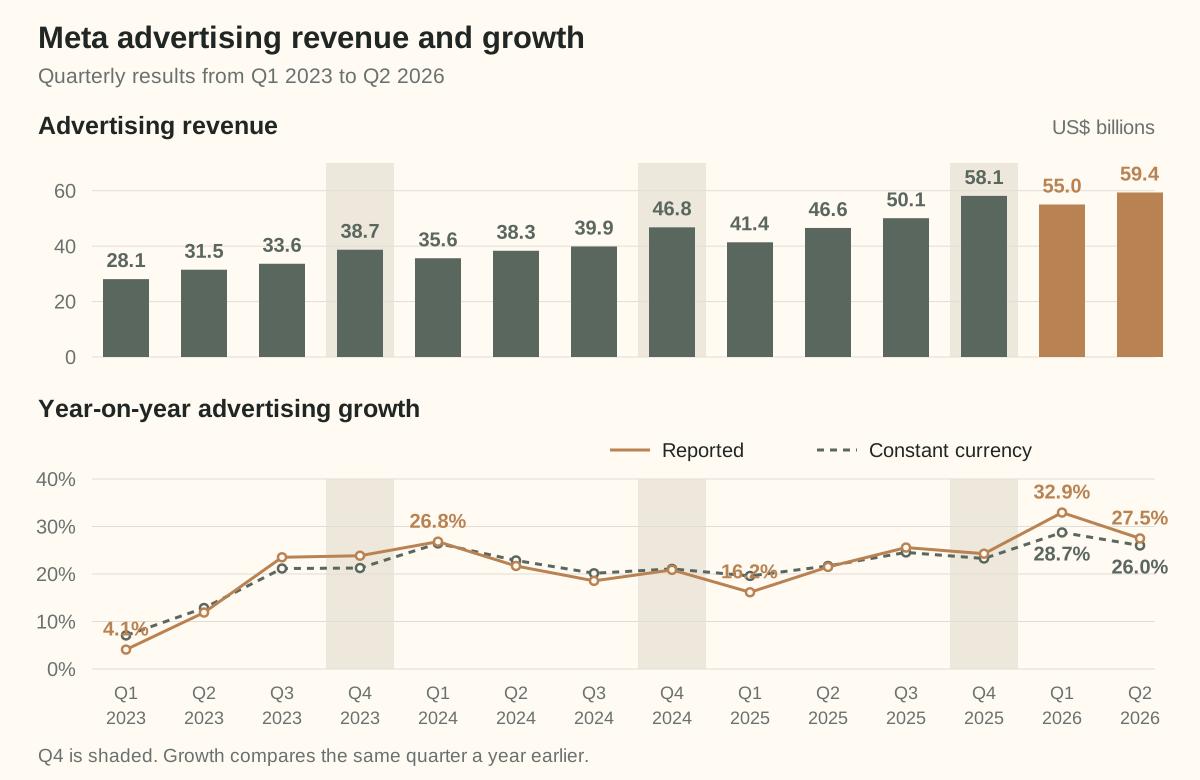
Source: Olduvai analysis, Meta earnings releases. Constant currency translates revenue at prior-year exchange rates.
Could AI open up new businesses for Meta?
AI could also bring Meta closer to the transactions that follow an advert. Better recommendations help people discover a business, while business messaging can turn an inquiry into a booking or purchase. Easier advert creation helps smaller businesses market themselves effectively. Together, these improvements could make Meta useful throughout more of the relationship between a business and its customers.
Muse, Meta's new personal AI assistant launched in September, takes this further. People can message it in its own app or on WhatsApp and ask it to do things, such as research a trip or arrange a purchase with their approval. It offers free access alongside subscription plans.
Over time, someone discovering a business on Instagram might use an assistant to compare options, book a service, and complete the purchase. Helping businesses through more of that process could generate revenue from transactions and other services. If Muse helps people decide what to buy, advertising could also become part of its future commercial model, although its role remains uncertain.
As similar AI tools become widely available, reaching customers and earning their trust may matter more. Privacy is part of earning that trust: Meta says Muse conversations and data in its private workspace are not shared with its advertising systems. Other assistants could win those relationships, but Meta starts with consumer and business connections built over many years.
How much is Meta investing?
Turning those possibilities into useful services requires capacity. Meta has historically built infrastructure primarily for its own apps and is now expanding it to improve advertising and support new services. Management describes securing land and power ahead of demand and retaining discretion over later chip and server purchases as needs develop. Sites can support successive generations of equipment, while chips are depreciated over their estimated useful lives.
The bill is already absorbing a larger share of the cash Meta generates. In the twelve months to June 2026, it generated $130.3 billion from operations and spent $92.4 billion on capital investment, leaving $37.9 billion. That remainder is free cash flow: operating cash flow less capital spending, including finance-lease principal. It was $52.1 billion in 2024.
Cash generation has grown, but less cash remains after investment. The latest quarter shows the pressure more sharply, with free cash flow of about $0.8 billion. Management expects capital spending of $130–145 billion for 2026, which could further pressure free cash flow even as the business grows. These figures cover the whole company, not AI alone.
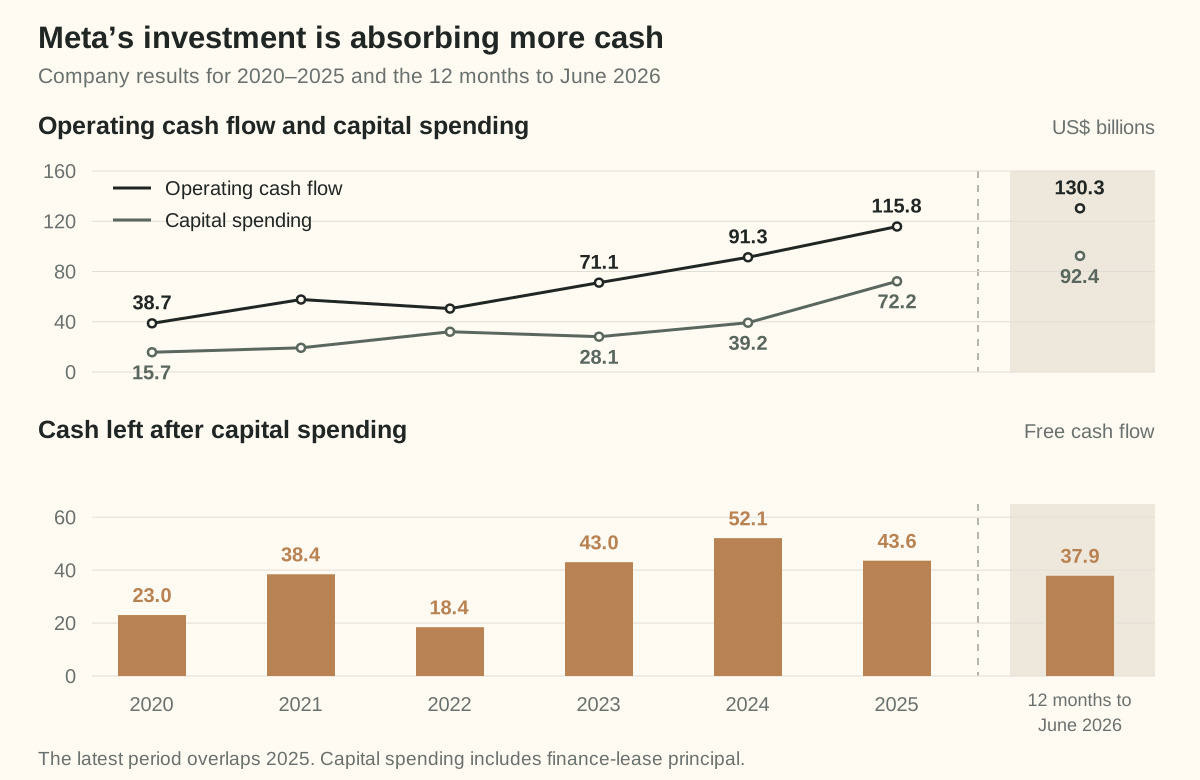
Source: Olduvai analysis, Meta earnings releases. The latest 12-month period overlaps 2025. Capital spending includes finance-lease principal. 2020 cash flow includes a $5 billion FTC settlement payment.
How can Meta make its AI investment pay?
Meta’s capital spending is a substantial commitment, but we believe it can generate an attractive return through several avenues. Its established advertising business gives it customers already paying for a service that AI can improve. New services offer additional possibilities, though with less certain returns.
First, advertising provides the foundation. Meta does not need to sell intelligence as a standalone product to earn from AI. Nor does it need to charge for AI usage by the token, the standard unit AI providers use to measure and bill model usage. By helping advertisers get more business from their budgets, Meta can make the platform more valuable and encourage them to spend more. Its infrastructure can therefore earn a return through advertising without a separate charge for computing.
Second, meeting its own needs can make ownership worthwhile. Buying from outside providers replaces some upfront investment with an ongoing bill. At Meta's scale, building and running its own models and infrastructure could leave it better off, while giving it more control over supply, provided capacity stays well utilized and equipment competitive. A lower cost per task can still mean a rising total bill if Meta is doing much more.
Third, new services like Muse could add to the return by putting capabilities Meta has already built to further use. If they cover their running costs and justify any extra investment, they improve the economics of shared spending. Free users also consume resources, so a larger audience will create value only if the commercial benefits justify the cost of serving it.
What does that leave for shareholders?
For shareholders, the question is how much additional cash the investment can generate after all its costs. Capacity earns a return when it supports profitable demand. If advertisers derive less value, or new services attract users without enough revenue to cover their costs, the same infrastructure can become a burden. Equipment that remains economical for longer improves the return; equipment that needs replacing earlier increases the bill. Competition and privacy or regulatory changes can affect both demand and profitability.
Higher investment can reduce free cash flow or turn it negative even as earnings grow. Our base case allows for several years of negative free cash flow and additional borrowing. Meta continued paying dividends but did not repurchase shares in the first half of 2026. Cash reserves and borrowing provide funding flexibility, but interest and share issuance also affect what each share ultimately earns. We therefore assess funding as well as the operating return.
As the investment develops, we watch whether advertisers continue to see better results and whether Meta earns more from the improvement. For new services, we look for repeat use, paying demand, and the cost of delivering the service. We assess whether those benefits and cost savings can justify the full investment over time. If spending rises without evidence of value, we would revisit our assumptions.
What are we paying?
A good business becomes an attractive investment when the price allows an adequate return for the wait and the risk. We begin with the earnings that Meta’s established advertising business can sustain, including the AI already used to improve it. We distinguish those earnings from the less-proven contribution of new services. We assess both their revenue and their costs.
That requires care with reported earnings. Infrastructure spending uses cash today, while depreciation spreads the cost over the years the assets are used. As more capacity enters service, that charge can rise. Our normalized earnings estimates aim to capture Meta’s underlying earning power. They allow for infrastructure costs, share-based pay, interest and taxes, as well as losses elsewhere in Meta. We also examine cash remaining after investment, because accounting earnings alone cannot show what is available to shareholders.
At roughly $725 per share at the end of September 2026, Meta trades at a multiple in the mid-20s of our estimated normalized earnings for the next twelve months. Our base case assumes continued advertising growth and improving operating efficiency, alongside substantial capital spending.
Over a four-year investment horizon, we see the potential for an attractive double-digit annualized total return.
Conclusion
We believe AI is likely to make Meta a better business. Its established advertising relationships provide a practical way to deploy AI and measure results, while new services could deepen those relationships. Meta can adjust future investment as evidence develops, although past spending and commitments limit that flexibility. Higher capital spending can create value when improved utilization and cash returns justify the full cost.
This is where our long-term perspective matters. Higher investment can depress today’s free cash flow while building tomorrow’s earning power, and worthwhile projects need time to mature. Our role is to assess what that spending can earn over its useful life and whether the share price offers sufficient compensation for the wait and the risk. Patience and capital discipline go together.