
Owning cyclical companies after a large move is never comfortable.
Memory has always punished complacency. Strong pricing leads to strong margins. Strong margins attract capital. Supply eventually catches up. Earnings fall. That history remains relevant. These are still cyclical businesses.
Recent conditions have been unusually favorable. Samsung's June 2026 quarter guidance implies very strong consolidated profitability, while market estimates suggest memory margins have been materially higher. SK Hynix has also reported exceptional margins by historical standards. We do not treat today's margins as permanent.
Instead, we ask what these companies can earn after margins contract, and whether those normalized earnings still support attractive long-term economics. The central question is whether AI is increasing not only peak earnings, but also the industry's long-term earnings floor.
What drives normalized earnings?
Normalized earnings in memory come down to four variables: volume, price, mix, and margin.
The most debated variables today are price and margin. Prices are high, and margins are exceptional. Neither will persist indefinitely. Higher prices will eventually attract more supply. If prices and margins both revert sharply, earnings will fall. That is the bear case, and it is a fair one.
Our counterpoint is volume and mix. AI servers require far more memory content than traditional servers. High-bandwidth memory is the most visible bottleneck, but it is not the only one. AI systems also need more server DRAM and more enterprise solid-state drives. We refer to these products collectively as enterprise memory.
Enterprise memory is more closely tied to AI infrastructure and cloud data centers than to traditional consumer electronics cycles. These products are harder to qualify, more performance-critical, and more closely aligned with customer roadmaps. They are not immune to cycles, but they should be less interchangeable than commodity memory sold into PCs or smartphones.
One way to see the change is in the composition of the memory market. Enterprise memory, defined as high-bandwidth memory, server DRAM, and enterprise SSDs, has grown from 26.5% of the memory market in 2020 to 43.1% in 2025 and is forecast to reach 51.9% by 2027.
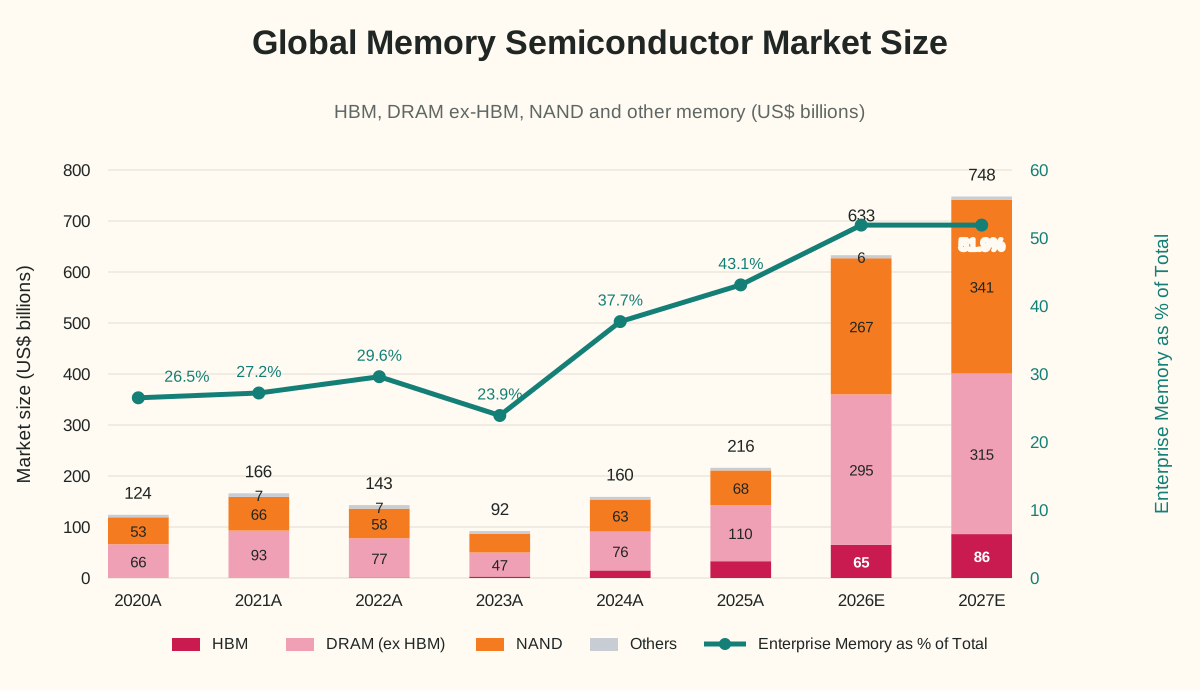
Source: Olduvai analysis, SK Hynix F-1 registration statement, Gartner forecasts and market data. Enterprise memory comprises HBM, server DRAM, and enterprise SSDs.
We do not treat those forecasts as a normalized run rate. The near-term revenue surge clearly reflects significant price inflation in both DRAM and NAND. In our view, the mix shift matters most. A lower margin on a larger, more enterprise-oriented revenue base can still produce attractive earnings power.
That is the question we are trying to answer: not whether 2026-style margins persist, but whether the industry's absolute earnings base is structurally higher than in prior cycles.
Could the next trough be higher?
If enterprise memory becomes a larger share of the industry, the next question is whether that changes the shape of the cycle.
The first reason it might is supply. Memory supply does not increase simply because capital expenditure is announced. New fabs require cleanrooms, power, tools, process migration, packaging capacity, engineering talent, customer qualification, and yield learning. This is especially true for high-end AI memory.
High-bandwidth memory is harder to manufacture and package than conventional DRAM. It also consumes more wafer capacity per delivered bit. As more wafers are allocated to HBM, the rest of the DRAM market does not automatically receive supply relief.
The second reason is customer qualification and co-design. Enterprise memory is more tightly aligned with customer roadmaps than traditional consumer memory. A hyperscaler building an AI cluster or a chip company designing its next accelerator platform cannot treat memory as a last-minute input. Performance, power consumption, packaging, and system architecture must work together.
The third reason is industry structure. DRAM has consolidated into a small group of global suppliers, with the top three controlling more than 90% of the market. NAND is less concentrated, but it is still dominated by a handful of scaled producers. Concentration alone does not remove cyclicality, but in a tight market it changes the customer conversation. Buyers are no longer simply negotiating price; they are negotiating access to qualified supply.
That is where long-term supply agreements become relevant. The details are still not fully clear, especially for Samsung and SK Hynix, and we are cautious not to overstate their protection. Contracts do not eliminate cycles. However, customers are increasingly accepting firmer volume commitments, deposits, or some form of price protection because the cost of not having qualified memory can exceed the cost of locking in supply.
None of this removes the cycle. It may, however, reduce the severity of the next downturn. A larger enterprise memory revenue base, better mix, longer qualification cycles, stronger customer commitments, and a more consolidated supplier base could all support a higher earnings floor than memory investors are accustomed to assuming.
What multiple is fair?
The valuation question follows from the earnings question.
Historically, memory companies deserved low multiples at peak earnings. That was rational. When earnings were driven mainly by short-term pricing, and customers could pull back quickly, peak profits were not worth much. A stock trading at four or five times peak earnings could still be expensive if those earnings were about to disappear.
We do not think the framework should be abandoned, but we do think it needs to be updated.
If a larger share of future earnings is tied to HBM, AI server DRAM, enterprise SSDs, longer qualification cycles, and multi-year customer commitments, then some portion of the profit pool is more durable than in prior cycles. That portion should not be valued as commodity shortage rent.
This does not mean Samsung or SK Hynix deserve software-like multiples. These remain capital-intensive semiconductor businesses with real cyclicality. But it does mean the old habit of applying a very low multiple to all memory earnings may be too punitive if the trough earnings base has moved structurally higher.
Our approach is to separate the earnings streams. Supernormal profits from broad DRAM and NAND shortages warrant a lower multiple. Earnings tied to strategic AI memory, customer qualification, longer-term agreements, and co-designed architectures warrant a higher multiple. The blended multiple should depend on how much of the business shifts from one bucket to the other.
There is also value in the profits earned today. During the current tight phase, leading suppliers are generating extraordinary cash flows. Those profits can strengthen balance sheets, fund AI-related capacity, enhance manufacturing and packaging capabilities, and leave room to return excess capital to shareholders through dividends or share repurchases.
Samsung and SK Hynix
SK Hynix is the clearest expression of the shift toward strategic AI memory. HBM is the most visible part of that shift, and Hynix invested early, executed well, and earned customer trust. Future returns depend less on discovery and more on delivery. If Hynix can sustain its position across HBM, advanced server DRAM, and other AI-related memory products, its through-cycle earnings power may be materially higher than historical levels suggest.
Samsung is a more complicated case. It missed parts of the early HBM cycle, and the market is right to demand evidence. But Samsung still has scale, financial strength, NAND exposure, advanced packaging capabilities, foundry optionality, and strategic relevance to every major AI customer.
Samsung does not need to displace SK Hynix in HBM or Taiwan Semiconductor Manufacturing Company in foundry for the investment question to become interesting. Establishing itself as a credible supplier of next-generation HBM, including HBM4, while participating in the broader AI memory mix shift, would be enough to improve the earnings trajectory. Any improvement in foundry credibility, particularly in AI silicon and custom accelerator programs where memory, logic, and packaging must be integrated, would add further optionality.
What could go wrong?
The risks are clear and go to the heart of the thesis.
The first risk is that price and margin normalization occurs faster than volume and mix can offset. Some of today's profits are driven by broad shortage pricing in conventional DRAM and NAND. If those profits fade quickly and enterprise memory does not grow enough to replace them, normalized earnings will be lower than expected.
The second risk is supply. The industry is planning large capacity additions for the latter part of the decade. The risk is not immediate oversupply in 2026. The more important question is whether the 2028-2031 capacity wave arrives amid still-growing, contracted AI demand, or whether it recreates the old memory-cycle problem.
The third risk is execution. Samsung still has to prove it can compete at scale in HBM4. SK Hynix has to defend its leadership as customers push for second sources. Qualification setbacks matter, and so does customer concentration.
There is also a risk that investors overgeneralize the high-end memory thesis. Not all memory is HBM. Not all DRAM is strategic. Not all NAND is enterprise AI storage. We need to separate structural earnings from shortage rents.
The bottom line
The case is not that peak margins persist. The case is that AI-related volume growth, a richer enterprise memory mix, longer qualification cycles, stronger balance sheets, and more strategic customer commitments may support a higher level of through-cycle profitability than memory investors typically assume.
The path will not be smooth. These remain cyclical semiconductor companies, and market volatility will periodically test the thesis as sentiment and expectations shift around hyperscaler AI capital expenditure, memory pricing, supply additions, customer ordering patterns, and execution.
The conclusion is simple: the cycle has not disappeared, but if the next trough is higher than the last, these businesses warrant a different valuation discussion.
More broadly, this reflects how we think about investing. Markets often anchor on historical averages while structural change quietly redefines what "normal" looks like. Our job is not to assume that every cycle is different, but to recognize when durable changes in demand, industry structure, or competitive advantage justify revisiting long-held assumptions.